
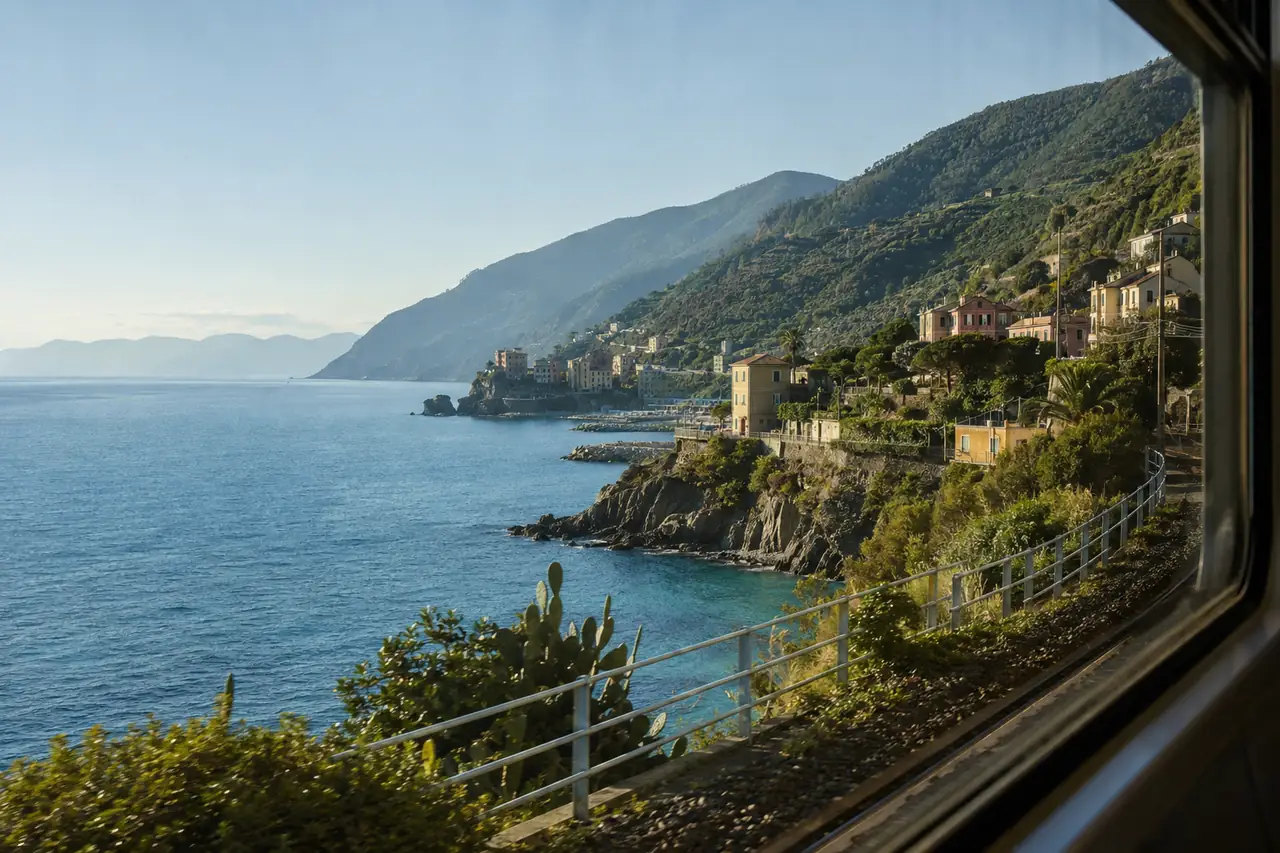
A useful order for booking
- Choose your overnight stops and number of nights.
- Check that every connection runs on your travel dates.
- Compare accommodation and transport costs together.
- Book the commitments that matter most, then add optional outings.
01 / The shape of the trip
Choose a route you want to spend time on
For a first attempt, we suggest two or three bases with direct rail connections. Each hotel change adds packing, check-out, travel and another arrival. Two nights give you one full day in a place; three nights make it easier to add a day trip without rushing.
Count nights before filling days with sights. Our eight-day Rome–Florence–Venice route, for example, has seven nights: three in Rome, two in Florence and two in Venice. Arrival and departure days are part of those eight days.
Rome → Florence → Venice
A useful starting point if you want a straightforward rail itinerary and time for museums and neighbourhood walks.
A slower coastal tripGenoa → Camogli → Levanto
Choose this for shorter regional rail journeys between Genoa, Camogli and Levanto. Treat boats as an optional outing.
Cities with a taste of the mountainsMilan → Verona → Bolzano
A northbound rail backbone, with buses and cable cars to check separately for mountain days.
A longer, more involved journeyMilan to Rome via the Dolomites & Amalfi
Six overnight stops in fifteen days. Choose it if you are comfortable with longer travel days and several changes of transport.
02 / Door to door
Plan more than the time on the train
Write down each journey as a complete chain: accommodation → departure station → train → onward bus or walk → next accommodation. Include the time to collect your bags and find the next stop. A fast train does not make a distant hotel convenient.
Check the full station name in the booking result. For our city route, Firenze Santa Maria Novella and Venezia Santa Lucia are the intended arrivals. Mestre is a different base from a stay in Venice itself. Save the station name with your hotel address.
Our rule for a connection
Find the next workable departure if you miss the one you planned. If there is no useful alternative, arrive earlier or change the overnight stop. Allow extra time for a station-to-port walk, unfamiliar platforms or luggage. There is no single transfer buffer that fits every journey.
On a flight-arrival day, leave time for baggage collection and the airport transfer before committing to a fixed train. If combining separate tickets, check what each operator will let you change if a delay breaks the connection.
03 / Before you board
Know which kind of ticket you bought
Compare the actual departures on Trenitalia and, where available, Italo. Read the fare conditions before paying: changing a cheap ticket may cost extra or be restricted. Italo’s fare comparison explains how its options differ. A journey-search result is a starting point; your purchased ticket’s conditions are what matter.
- Trenitalia long-distance ticketless ticket
- Keep the booking reference (PNR), train, coach and seat details available. This format does not need a paper ticket collected from a machine. Ticketless instructions.
- Trenitalia Digital Regional Ticket
- It activates automatically at the scheduled departure of your selected train. If you need a different departure, change it before that time. Show the ticket on your device with its dynamic green bar; a screenshot is not a substitute. Have identification available.
- Trenitalia single paper regional ticket
- Validate it in a station validating machine before boarding. If the machines do not work, contact train staff before boarding rather than assuming the ticket is ready to use.
Source: Trenitalia’s regional ticket rules. The Electronic Regional Ticket is a separate format that does not require validation. Other operators and ticket products can have different instructions — follow the ones supplied with your ticket.
04 / A base that works
Choose accommodation around the last kilometre
Map the walking route from the station, bus stop or pier before reserving. Check steps, hills, bridges and late check-in as well as distance. “Near the station” is useful only if the actual entrance is convenient for you and your bags.
Ask the property about lifts and access if either matters to your trip. Confirm luggage storage for the gap between checkout and departure. In a mountain village, proximity to the bus you will actually use can matter more than proximity to the village centre.
Compare the total cost of the stay: room, local transport, baggage storage and any transfer you would need. Keep a separate budget for food, sights and optional outings. A cheaper room with awkward connections may not be the cheaper trip.
05 / What you carry
Pack for the hardest transfer
Before leaving, try carrying your packed bag up a flight of stairs and walking with it. Reduce the load if that is difficult, or plan the assistance you need. Keep your ticket, ID, medication and charger accessible without opening the main bag.
Do not assume one luggage allowance covers the whole trip. For example, Italo’s luggage policy sets a 75 × 53 × 30 cm limit for luggage in Smart class. Check your class and any special-item rules before booking. A ferry or bus on the same route may have its own limits or charges.
06 / Beyond the railway
Check the last connection first
For a day out, establish the return journey before choosing the outward departure. Check the exact date, direction and stop, including weekday or holiday notes. Save an earlier return as an option if the outing takes less time than expected.
For the Bolzano and Dolomites parts of our guides, use südtirolmobil’s route timetables and live service notices. Check individual cable-car opening dates separately before making a lift the centrepiece of a day.
For Amalfi Coast boats, confirm the departure pier and operating dates with the operator. Travelmar’s conditions allow changes or cancellations and specify luggage charges beyond its included allowance. Keep a land alternative in your plan; do not make the last boat your only route to an onward flight.
Recheck service notices the evening before a travel day and again before setting out. Saved timetables help you plan, but they will not tell you about a new disruption.
07 / Tickets, maps and messages
Keep your plans accessible
Save hotel addresses, booking references and offline maps before departure. Download tickets in the format the operator supports; keep live tickets accessible in the relevant app or link. Carry enough battery for your travel day.
Check whether your current mobile plan already includes data in Italy. If it does not, compare a roaming add-on with a local SIM or travel eSIM. Airalo is one option; its service needs an eSIM-compatible, network-unlocked device. Check device compatibility and the package’s data allowance and validity before buying.
Affiliate link: Car-Free Atlas may earn a commission if you buy through this link.
View Airalo Italy plans08 / One final pass
Your departure checklist
- Every overnight stay matches the arrival date in your transport plan.
- You have checked full station names, bus stops and departure piers.
- You know the validation or activation rules for each ticket.
- You have checked the last return and one alternative for each day trip.
- Your accommodation’s arrival instructions and luggage arrangements are saved.
- You can carry your bags, or have arranged the help you need.
- Tickets, ID, addresses and a charged phone are accessible.
- You have rechecked operator notices for your next journey.
This is a planning guide, not a live timetable or fare quote. Operator information linked above was checked on 8 September 2026. Our suggestions about pace, bases and transfer buffers are editorial advice. Check current conditions for your dates before paying.
Our editorial standards and affiliate disclosure